Showing posts with label fantasy map. Show all posts

23 December 2025

Vvardenfell Map in the Style of RuneScape

In the setting of the Elder Scrolls games, the alien, volcanic island of Vvardenfell makes up the northern part of the province of Morrowind, in the northeastern corner of Tamriel. Vvardenfell is the setting for the third Elder Scrolls game, named Morrowind after the province, and this year I've been drawing it in the pixelated style of RuneScape.

Vvardenfell mapped in the style of RuneScape (full-size version)

In the rest of this post I'll talk about how the map came about and describe some of the creative choices made along the way.


Beyond Skyrim

I made the map of Skyrim in the style of RuneScape in summer 2020 as a way to stay entertained at the height of the Covid lockdowns. After that, I experimented with some other ideas, including Stormwind from World of Warcraft and the Imperial City from Skyrim's predecessor Oblivion.
Imperial City, from The Elder Scrolls IV: Oblivion, in the style of RuneScape
Although I'm too young to have played Morrowind when it came out, Vvardenfell seemed very compelling as a place to depict in RuneScape's style. Morrowind and RuneScape are about the same age, and have a similar open-ended design philosophy. Moreover, Vvardenfell is an island of stark contrasts, including salt marshes in the southwest, barren islands in the east, rocky highlands in the northwest and an ash-covered wasteland in the centre, all of which seemed really cool to combine into one map.

The most important decision, and the hardest to change once the map was underway, was the scale. My first thought was to draw the Vvardenfell map at the same scale as the Skyrim map so that the two maps could connect if shown side-by-side. It would mean that, in theory, I could grow the map even further over time to eventually build up a complete map of the continent of Tamriel.

However, a few reasons pushed me towards developing a different scale for the Vvardenfell map:
  • In-game, Skyrim and Vvardenfell are depicted at different scales. In the series lore, the province of Skyrim is more than twice as big as Vvardenfell, but the world is depicted at a larger scale in Morrowind so that the game's playable area is only slightly smaller than it is in Skyrim.
  • My RuneScape-style mapmaking skills have improved a bit since I made the Skyrim map, and I developed a few tools to help speed up the mapmaking process. This meant I could be comfortable making a map which was a little bit larger than before.
  • Joining the maps would have been a bit weird anyway, since Skyrim and Morrowind are set more than 200 years apart, with significant political and geographical changes in between (especially to Vvardenfell).
Because of this, I started fresh with the scale, resulting in a map which was bigger than the map for Skyrim but still manageable to draw. As for the Skyrim map, I scaled up the sizes of towns and cities compared to the surrounding areas.
My Excel plan for the Vvardenfell map.
Each grid square represents one RuneScape "chunk", 192 by 192 pixels on the final map.

Working smart, not hard

Although the Vvardenfell map is bigger than the Skyrim map, I had a few techniques and tools to speed up the process.

For the terrain base layer, rather than blend all the colours by hand like I did for the Skyrim map, I painted solid blocks of colour. Then I used Inkscape's Gaussian blur and pixelate effects to convert the terrain into RuneScape's style. This was not only faster, but also made it easier to go back and make changes if (for example) I wanted to tweak a region's colour palette.
Terrain blending
Rather than place every rock and tree individually, I wrote a Python script to fill regions of the map with randomly-placed sprites, automatically aligned to the grid defined by the pixelated base terrain layer.

Another Python script was used to smooth the edges of mountains, making them conform to straight lines like they usually do on the RuneScape map. The effect is subtle but goes a long way towards giving the mountains the right feel.
Mountain smoothing

"What a grand and intoxicating innocence ..."

In-game, Vvardenfell is surrounded by an infinite ocean, but community modding projects have set out to depict the mainland described in lore. Most notably, Tamriel Rebuilt is a project to bring the rest of the Morrowind province to the game, extending the playable area to six times what's shown in the retail game, while still staying faithful to Morrowind's game design philosophy.

I was very keen to include some of the content from Tamriel Rebuilt on the Vvardenfell map, especially the parts that fit inside Vvardenfell's bounding box. Although I did make progress on this, including getting some nice depictions of Althoa, Firewatch and Old Ebonheart, I did run into some stumbling blocks.

In particular, while Tamriel Rebuilt has been consistently releasing new regions, many areas are still unfinished or with significant overhauls planned. The Clambering Moor to the southwest of Vvardenfell is an example of the former, while Dagon Urul to the northeast is an example of the latter.
Althoa, northeast of Vvardenfell, from Tamriel Rebuilt
Because of this, and because Old School RuneScape's player-designed island competition needed its entries (even joke entries like mine) submitted before 7 January, I decided to put these ambitions on hold and focus on Vvardenfell itself. Still, the outline of mainland Morrowind still appears on the map in pale grey (for this, I'm indebted to the Tamriel Rebuilt masterplan map overseen by Tiny Plesiosaur), and the Saros caldera is the "rekindled" version from Tamriel Rebuilt rather than the version from the Fort Firemoth DLC.

I'd still be very keen to come back and finish the Tamriel Rebuilt areas, either basing them off the extensive maps and concept art that are already available or waiting until those areas have been developed more fully.

Until then, thank you for reading this far, and I wish you wealth beyond measure. To finish off, here is Solstheim as it appears in Morrowind's Bloodmoon expansion.
Solstheim, from Bloodmoon, in the style of RuneScape


30 December 2020

Stormwind Map in the Style of RuneScape

After trying my hand at adapting Skyrim's world map to the style of RuneScape, I was in search of another location that could work well with that distinctive pixellated look. Stormwind City, the largest human settlement in the online role-playing game World of Warcraft, is one of the most iconic cities in gaming, so seemed like an obvious choice.

Stormwind map in the style of RuneScape

There isn't too much to say on methodology. In fact, the biggest practical challenge when researching the map was persuading my brother to let me borrow his World of Warcraft account so that I could fly around and take screenshots of the city layout.

Stormwind as it appears in World of Warcraft

For those who are curious, this is what the map looks like without the icon and text label layers:

Map without icons or labels

How ambitious a task would it be to adapt the whole of World of Warcraft to RuneScape's style? Obviously the short answer is "very", but we can get a more precise answer with some back-of-the-envelope calculation.

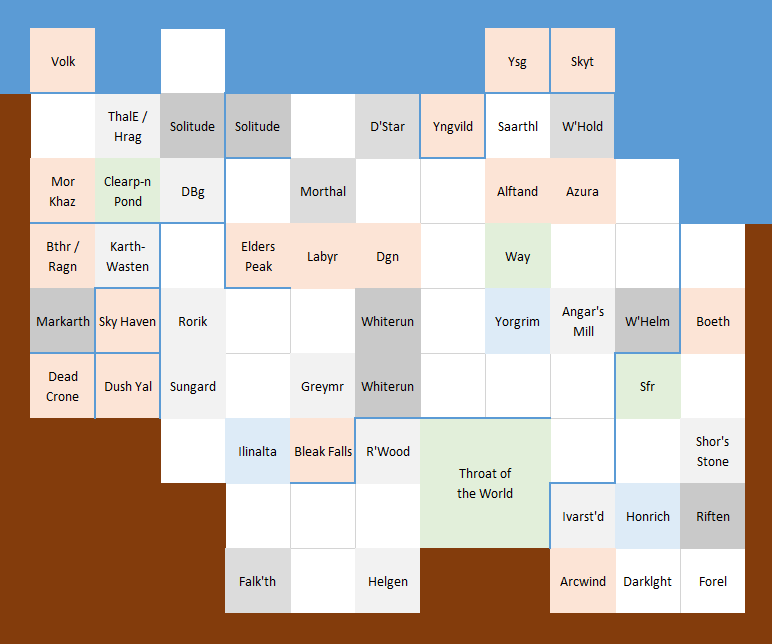
When adapting Skyrim, my quick-and-dirty way of planning out the map was to allocate Skyrim's cities and adventuring sites to RuneScape's 192-by-192-pixel "chunks". Generally, RuneScape has one major feature per chunk, with a few big locations (like cities) occupying multiple chunks.

We can see this in the map below, which takes the official Old School RuneScape world map (as of December 2020) and labels the main feature each chunk. The game world has about 450 chunks of landmass, around half of which contain some kind of landmark. Chunks coloured blue are mostly ocean, while grey chunks are currently "unknown" and appear black on the official map.

Outline of RuneScape's map
(full-size version)

If we took the map of World of Warcraft's Eastern Kingdoms (where Stormwind is situated) and allocated the main locations to RuneScape-style chunks, we would get something like the below:

World of Warcraft's Eastern Kingdoms divided into chunks
(full-size version)

If the map above were used as a basis for a full map, the whole Eastern Kingdoms (excluding underground and underwater areas) would take up about 270 RuneScape chunks. The whole map would be 3264 by 8064 pixels in size.

Add in Kalimdor (the other continent dating back to "classic" World of Warcraft) and you have another 300 or so chunks to map. The two continents, with a combined landmass larger than the whole world of RuneScape, would almost definitely make for a mapping task too large for any one person to take on!

16 September 2020

Skyrim Map in the Style of RuneScape

When encountering a new world for the first time, few things fuel the imagination quite like a map. A map can also be one of the biggest sources of nostalgia when looking back at a world that was once very familiar. My most recent geeky project has been to take the map from the video game Skyrim and translate it into a more retro style, re-imagining it in the style of another video game, RuneScape:

Map of Skyrim in style of RuneScape
Skyrim map in the style of RuneScape (full-size version)

For those curious to know more, the rest of this post will describe the process of making the map in a little more detail. After a bit of background on the two games which motivated it, I'll say a little bit about three aspects which brought interesting challenges: the scale, the terrain, and the icons on top.


Two games, two worlds 

(You can almost certainly skip this section if you're familiar with RuneScape and Skyrim - and if you're here from Reddit or Twitter, you almost certainly will be)

RuneScape was originally released by British developer Jagex in 2001. The distinctive world map style I was seeking to emulate first appeared in 2004, and is still used in the game's Old School fork:

Excerpt from official RuneScape map, showing Taverley, Burthorpe and Falador
Excerpt from official RuneScape world map

Skyrim, the fifth title in The Elder Scrolls series, was released by American developer Bethesda Game Studios in 2011. Each game in the series is set in a different region of the fantasy continent of Tamriel; the fifth game is set in the cold northern province of Skyrim, heavily influenced by Norse mythology.

Skyrim's official world map

The two games have a lot in common. Both games are set in fantasy worlds with wizards, elves and dragons. The player takes the role of an adventurer who goes on quests, defeats monsters and hones their skills at combat and crafting. Both titles had an impact which lasted long after their original release: they are still played, they are still talked about and they continue to spawn memes.

Why choose Skyrim and RuneScape for a cartographical crossover? Skyrim is one of the best-selling role-playing games of all time, making the eponymous province one of the most famous video game worlds ever crafted. RuneScape's retro, pixellated map evokes a lot of nostalgia for those (like me) who spent a lot of their childhoods using it. The wealth of resources available for map-making fans means the style is not too tricky to replicate (despite my limited artistic skill).


Scale

Almost all video games distort scale. A city might have thousands of inhabitants according to the story, but creating all of them would be a significant waste of resources if only a dozen are relevant to the player.

The challenge with translating Skyrim to RuneScape's style is that the two games treat scale very differently. Skyrim, from a story perspective, is meant to be the size of a real-world country, but in-game the world is about 37 square kilometres in size. The world of RuneScape spans several kingdoms (also meant to be country-sized), but is compressed in-game to an area less than five square kilometres.

Skyrim, where "major city" means twenty buildings 

The two games also differ in what they emphasise. In RuneScape, cities and towns are inflated relative to their surroundings. In the oldest areas, they take up about a third of the map. Skyrim, by contrast, has much larger areas of open wilderness. I think this is in part because RuneScape is a multiplayer game with an emphasis on player interaction, while Skyrim is single-player; another reason could be RuneScape's slightly greater emphasis on non-combat skills (which exist in Skyrim but play a smaller role).

All of this means that drawing Skyrim in RuneScape's style would not simply be a case of tracing over one map with the colour palette of the other. Although the map might look like Skyrim, it would not feel at all like RuneScape.

Instead, my plan was to enlarge cities and shrink the surrounding wilderness, just like RuneScape does. The first thing I did was try to figure out how I could do this while still representing Skyrim as closely as possible.

Skyrim's features mapped onto a grid
My original plan for the map

The resulting scale is a compromise: roughly 15% of the map is covered by towns and cities, less than RuneScape but much more than Skyrim. It did mean that occasionally a location from Skyrim had to be cut for space, but I always tried to prioritise keeping the most iconic places. Sorry, Narzulbur.

Aligning Skyrim to a grid helped to make the map seem more RuneScape-like in another, more subtle way. RuneScape's map is made out of "chunks" about 200 by 200 pixels in size; each chunk is loaded separately in-game and often has a unique background music track. Towns and terrain features are typically designed to line up with these chunks, which can make continents look quite "square". Planning Skyrim's map in terms of these chunks gives the world a similar rectangular feel, even if it's something people might only notice subconsciously.

"Chunk" grid overlaid on Skyrim map


Terrain

Terrain in a RuneScape-style map has two ingredients. The base layer, representing grass, dirt, sand or snow, blends between different colours, while mountains and bodies of water are shown as solid colours with sharp boundaries.

Again, the process of making the map reveals a difference in emphasis between Skyrim and RuneScape. In particular, Skyrim loves mountains, using them not only as sites for adventure but also to create natural barriers between different regions. Unlike RuneScape's world surrounded by ocean, Skyrim is bordered on three sides by mountain ranges.

The southwest corner of the map posed a conundrum: in Skyrim, this area is blocked off to the player and a lot of it is left blank.

Excerpt from the UESP Skyrim map, showing the featureless southwest corner

I considered covering the area in shadow or sticking the map key there, but in the end I opted to fill in the terrain as minimally as possible, so that the area wouldn't be distractingly busy or distractingly empty.


Icons

If a map style is a language, the icons speak most clearly. Sure, the text labels might tell you what a place is called, but the icons tell you why they matter.

RuneScape uses map icons extensively, identifying resources (e.g. fish or ore), facilities (e.g. a furnace or an anvil), non-player characters offering services (e.g. a shop or transportation) or starting points for an adventure (e.g. a quest or a dungeon).

Examples of map icons in RuneScape: general store, flour mill, quest, dungeon

In many cases, such as those pictured above, the icons used in RuneScape fit very naturally in Skyrim. In other cases the games don't match as neatly. In particular, one of the most important services for players in RuneScape is the bank, where players can store their gold and items. These don't exist in Skyrim, so RuneScape's iconic dollar-sign bank icon is nowhere to be seen.

Conversely, many of Skyrim's features lack an exact analogue among RuneScape's icons but are still the kind of thing you would want to indicate on a map. Most importantly, dragons play a key role in Skyrim's story and their lairs are landmarks in their own right. A new icon marking the presence of a dragon, based on the icon used in Skyrim, seemed like an obvious inclusion.

Skyrim's icon for dragon lairs, and my RuneScape-style interpretation


"You're finally awake ..."

Whether it's words or worlds, no translation can ever be exact. I am conscious that some of the decisions which went into this map might be controversial, especially when figuring out how heavily to draw from RuneScape and how heavily to draw from Skyrim. Nevertheless, I hope that the map manages to capture the setting of one world, the character of another, and the nostalgia of both.